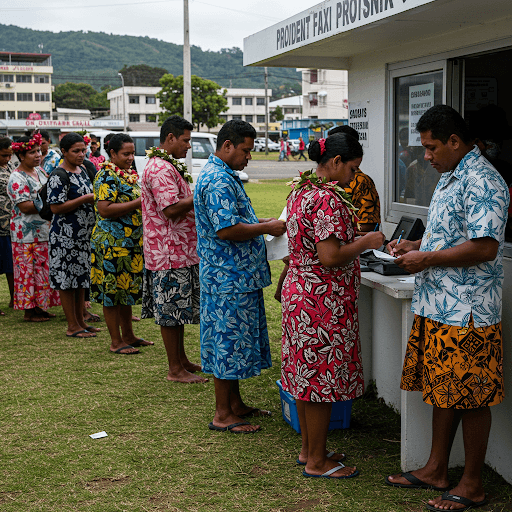
For many taxpayers in Fiji, especially those earning salaries, income tax is conveniently deducted throughout the year via the Pay As You Earn (PAYE) system. However, if you earn significant income from sources without withholding tax – such as profits from your own business (sole trader, company, partnership share), rental income, or substantial investment income – you generally can't wait until year-end to pay your entire tax bill. The Provisional Tax (PT) system requires you to pay your estimated income tax liability in instalments during the income year. Understanding how this system works and ensuring compliance is vital for managing cash flow and avoiding penalties from the Fiji Revenue and Customs Service (FRCS).
What is Provisional Tax?
Provisional Tax is essentially an advance payment system for income tax. It's designed to ensure that taxpayers with income not subject to withholding pay their tax liability progressively throughout the year, similar to how employees pay tax via PAYE. These advance payments are then credited against the final income tax liability calculated when the annual income tax return is filed.
Who Needs to Pay Provisional Tax?
You are generally required to pay Provisional Tax if:
You are an individual, company, trust, or other entity liable for income tax in Fiji.
You expect your Residual Income Tax (RIT) for the year to be FJD 1,000 or more.
Residual Income Tax (RIT) is your total estimated income tax liability for the year minus any tax credits you're entitled to (including tax already withheld at source, like PAYE).
So, if you run a business, receive significant rental income, or have other earnings where tax isn't deducted upfront, and your final tax bill (after considering any withholdings) is likely to be FJD 1,000 or more, you will likely fall into the Provisional Tax regime.
The 'Registration' Process: How Obligations Arise
Unlike VAT, PAYE, or FBT, there isn't typically a separate, distinct "Provisional Tax Registration" application you need to actively file via the Taxpayer Online Service (TPOS) portal to start the obligation. Instead, your requirement to pay Provisional Tax usually arises in one of these ways:
FRCS Notification: Based on the income tax return you filed for the previous year, if your RIT was FJD 1,000 or more, FRCS will generally automatically calculate your Provisional Tax liability for the current year and notify you (often via TPOS or correspondence). This notification will detail the total PT amount and the instalment payment schedule.
Self-Assessment: If you are starting a new business or anticipate a significant increase in income (not taxed at source) that will result in an RIT of FJD 1,000 or more for the current year, you have an obligation to estimate your liability and start paying Provisional Tax instalments accordingly, even if FRCS hasn't yet notified you based on past returns. You would manage these payments via TPOS.
Therefore, the "registration" is fundamentally tied to having your primary TIN and meeting the RIT threshold. The process is more about becoming liable and then managing the payments through TPOS, rather than actively 'adding' PT as a tax type like VAT or PAYE.
Calculating Provisional Tax Liability
FRCS typically uses the standard method (or uplift method) to calculate your Provisional Tax liability. This is generally based on your previous year's RIT, uplifted by a certain percentage (e.g., 5% or 10% - check current FRCS guidelines) to account for potential income growth.
However, taxpayers have the option to use the estimation method. If you believe your income (and therefore your RIT) for the current year will be significantly different from the standard calculation (e.g., much lower due to changed circumstances, or much higher due to growth), you can estimate your PT liability and pay based on that estimate. You must notify FRCS via TPOS if you choose to use the estimation method. Be cautious, as underestimating significantly can lead to penalties.
Payment Schedule
Provisional Tax is usually payable in three instalments throughout the tax year. The specific due dates depend on your balance date (financial year-end). For taxpayers with a standard December 31st balance date, the typical due dates are:
1st Instalment: August 31st
2nd Instalment: November 30th
3rd Instalment: March 31st (of the following year)
Check FRCS guidelines for definitive dates, especially if you have a non-standard balance date. Payments are made electronically via TPOS or other approved methods.
Importance of Compliance: Avoiding Penalties
Paying the correct amount of Provisional Tax by the due dates is crucial. FRCS imposes penalties for:
Late payment of instalments.
Underestimation of Provisional Tax (if using the estimation method and the estimate falls below certain thresholds compared to the actual RIT).
These penalties can add significantly to your overall tax cost.
Tax Pro Fiji: Managing Your Provisional Tax Obligations
Navigating Provisional Tax requirements – understanding if you're liable, calculating the correct amounts (especially if estimating), and ensuring timely payments – requires careful financial planning and awareness of FRCS rules.
Tax Pro Fiji provides comprehensive support for Provisional Tax compliance:
We help you determine if you are liable for Provisional Tax based on your income sources and estimated RIT.
We assist in calculating your PT liability, whether using the standard method or helping you make reasonable estimates if circumstances require.
We manage Provisional Tax payments via TPOS on your behalf, ensuring they are made accurately and on time.
We advise on strategies to manage cash flow around PT due dates.
We help you reconcile PT payments against your final income tax liability when filing your annual return.
We handle communications with FRCS regarding your PT obligations.
Stay ahead of your income tax payments and avoid unnecessary penalties.
Contact Tax Pro Fiji today for expert assistance with calculating and managing your Provisional Tax obligations.
Key Citations:
Fiji Revenue and Customs Service (FRCS): frcs.org.fj
FRCS Taxpayer Online Service (TPOS): Accessible via the main FRCS website (used for managing and paying PT).
Income Tax Act 2015: Part 10 and associated regulations govern Provisional Tax.
Tax Administration Act 2009: Sections related to penalties for late payment or underestimation.
FRCS Provisional Tax Guides & Practice Notes: Provide details on calculation methods, thresholds, due dates, and penalties (available on FRCS website).