When a person passes away in Fiji, their assets (like bank accounts, property, shares) and liabilities (debts) collectively form their "Estate." These assets cannot simply be accessed or distributed by family members directly. A formal legal process, known as Estate Administration, is required to manage the deceased's affairs, settle their debts, and legally transfer the remaining assets to the rightful beneficiaries or heirs. While sometimes thought of as "Estate Registration," the core involves obtaining legal authority from the High Court of Fiji to administer the estate.
What is Estate Administration? Probate vs. Letters of Administration
Estate Administration is the court-supervised process of dealing with a deceased person's estate. The specific path depends on whether the deceased left a valid Will:
Probate: If the deceased left a legally valid Will naming an Executor (the person appointed to carry out the Will's instructions), the Executor must apply to the High Court of Fiji (Probate Division) for a Grant of Probate. This Grant confirms the Will's validity and officially authorises the Executor to manage the estate according to the Will's terms.
Letters of Administration: If the deceased died intestate (without a valid Will), or if the Will doesn't name an Executor or the named Executor is unable/unwilling to act, an eligible person (usually a close relative, like a spouse or child, according to rules of priority) must apply to the High Court for Letters of Administration. This Grant appoints an Administrator and authorises them to manage and distribute the estate according to Fiji's intestacy laws (rules set out in legislation, like the Succession, Probate and Administration Act (Cap 60), which dictate who inherits in the absence of a Will).
In essence, both Probate and Letters of Administration are official court documents that "register" the authority of the Executor or Administrator to legally act on behalf of the estate.
Why is Formal Administration Necessary?
Financial institutions (banks), the Land Titles Office, share registries, and other entities holding the deceased's assets require proof of legal authority before releasing funds or transferring ownership. The Grant of Probate or Letters of Administration provides this proof. It ensures that:
Debts and taxes owed by the deceased are paid correctly.
Assets are distributed legally to the correct beneficiaries (as per the Will) or heirs (as per intestacy laws).
The Executor or Administrator is legally empowered and protected when carrying out their duties.
Disputes over the estate can be managed within a legal framework.
Attempting to deal with significant assets without this formal authority is usually impossible and can lead to legal complications.
The Process: Key Steps in Estate Administration
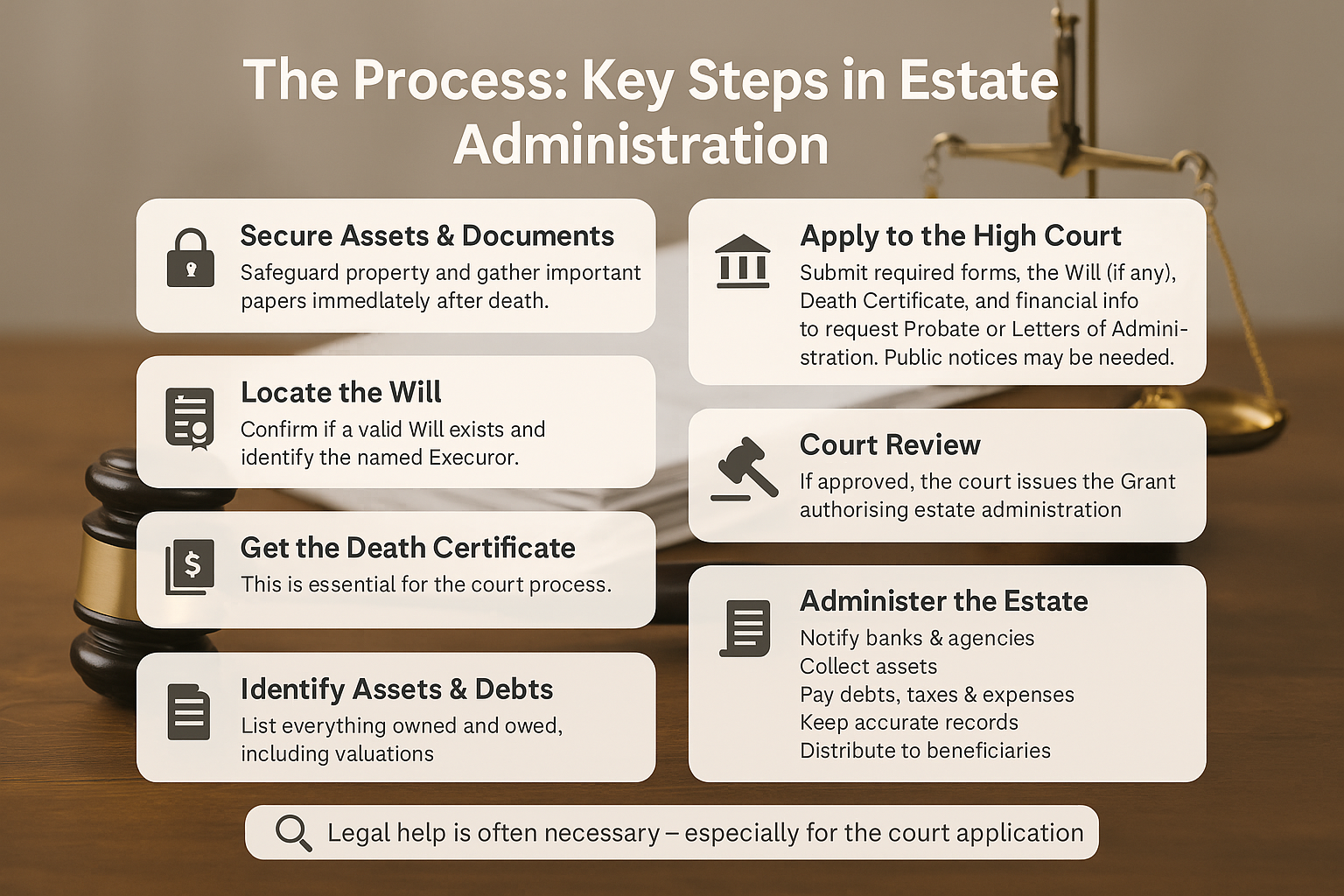
While each estate is unique, the general process involves:
Secure Assets and Information: Immediately after the death, secure any known assets and important documents.
Locate the Will (if any): Determine if a valid Will exists and identify the named Executor.
Obtain Death Certificate: This official document is required for the court application.
Identify Assets and Liabilities: Compile a detailed list of everything the deceased owned and owed at the time of death, including valuations where necessary.
Apply to the High Court: The potential Executor or Administrator, usually with legal assistance, prepares and files the application for Probate or Letters of Administration. This involves submitting forms, affidavits (sworn statements), the original Will (if applicable), the Death Certificate, and details of assets/liabilities and beneficiaries/heirs. Public notice or advertisement may be required.
Court Review and Grant: The High Court reviews the application. If everything is in order, the Court issues the Grant of Probate or Letters of Administration.
Administer the Estate: Once authorised, the Executor/Administrator must:
Notify banks, government agencies, etc., of the death and their authority.
Collect all assets belonging to the estate.
Pay all legitimate debts, funeral expenses, and any taxes owed by the deceased or the estate (see below).
Prepare accounts showing all transactions during the administration period.
Distribute the remaining assets to the beneficiaries according to the Will or intestacy laws.
Finalise the Estate: Once all assets are distributed and tasks completed, the Executor/Administrator may need to file final accounts with the Court or beneficiaries.
This process, especially applying to court, often requires legal expertise due to the specific forms, procedures, and legal requirements involved.
Tax Considerations During Estate Administration
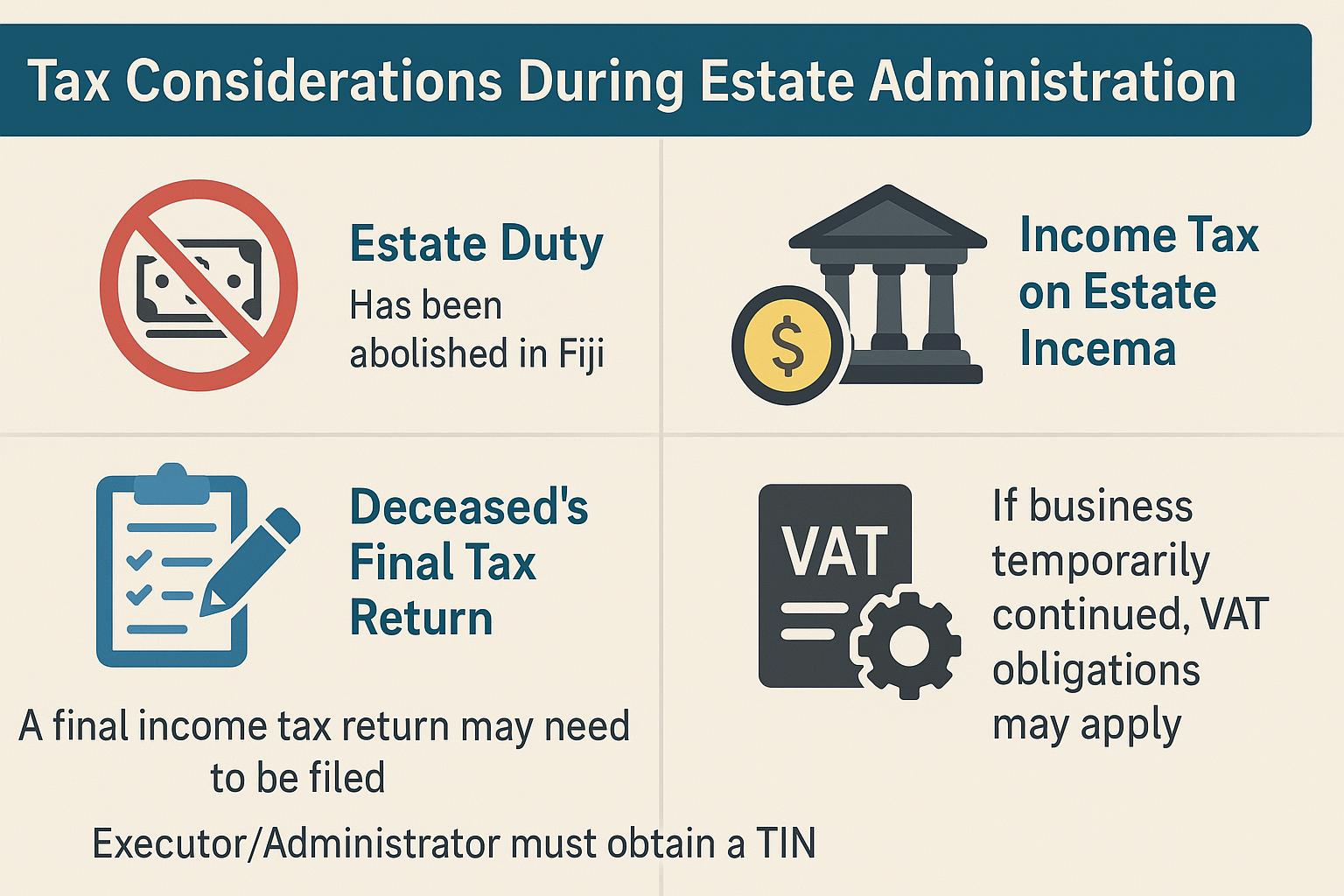
The Executor or Administrator is also responsible for addressing the estate's tax obligations with the Fiji Revenue and Customs Service (FRCS):
Estate Duty: It's important to note that Estate Duty (a tax on the total value of the estate) has been abolished in Fiji.
Deceased's Final Tax Return: A final income tax return may need to be filed for the period up to the date of the deceased's death.
Income Tax on Estate Income: Income earned by the estate's assets after death but before distribution to beneficiaries (e.g., rental income from property, interest on bank accounts) is generally taxable. The Executor/Administrator must obtain a Tax Identification Number (TIN) for the estate itself, file income tax returns for the estate during the administration period, and pay any tax due from the estate's funds.
VAT: If the deceased was operating a business registered for VAT, and the Executor/Administrator continues that business temporarily during administration, VAT obligations may continue. Advice should be sought.
Managing the Financial Aspects with Professional Help
Estate administration involves significant financial responsibility and record-keeping. The Executor/Administrator must account accurately for all assets collected, debts paid, and distributions made. Failing to manage the finances properly or meet tax obligations can lead to personal liability for the Executor/Administrator.
Tax Pro Fiji provides crucial support to Executors and Administrators in managing the financial and tax aspects of estate administration:
Applying for the Estate's TIN: We assist in obtaining the necessary Tax Identification Number from FRCS for the administration period.
Estate Income Tax Returns: We prepare and file the required income tax returns for income earned by the estate during administration.
Final Tax Returns: We can assist with the preparation of the deceased’s final personal income tax return.
VAT Advice: If a business continues, we provide guidance on VAT compliance.
Financial Record Keeping: We help set up systems or manage the record-keeping necessary for accurate accounting to beneficiaries and potentially the Court.
Guidance on Tax Clearances: Assisting in ensuring all tax obligations are met before final distribution.
Let Tax Pro Fiji handle the complex tax and financial accounting duties, allowing Executors and Administrators to manage the estate administration process more smoothly and confidently.
Contact Tax Pro Fiji today for expert assistance with the financial and tax requirements of Estate Administration in Fiji.
Key Citations:
High Court of Fiji (Probate Division): (Handles applications for Probate/Letters of Administration)
Succession, Probate and Administration Act (Cap 60): Via Fiji Laws website.
Wills Act (Cap 59): Via Fiji Laws website.
Fiji Revenue and Customs Service (FRCS): frcs.org.fj (For TIN and Tax requirements)
Income Tax Act 2015: Sections relevant to taxation of deceased estates.